Air Fryer vs Convection Oven: Which Cooks Better for Your Kitchen in 2026?
We compare crispiness, cooking speed, capacity, versatility, energy use, counter space, cleanup, and cost so you can choose the hot-air appliance that fits how you cook, how many people you feed, and how much room you have.
At a Glance
Choose an air fryer if you cook mostly for one to three people, love crispy food, want the fastest results with minimal preheating, and value easy cleanup—it's an excellent, affordable addition to almost any kitchen. Choose a convection oven if you feed a larger family, bake regularly, cook sheet-pan meals or big roasts, or want a single appliance that handles the widest range of dishes; a countertop model is a great alternative to heating a full-size oven. In 2026, many households will be happiest with an air fryer toaster oven combo, which blends convection capacity with strong air-fry performance, or with a compact air fryer alongside a range that already has a convection setting. Measure your counter space first and choose the appliance that fits the meals you actually make.
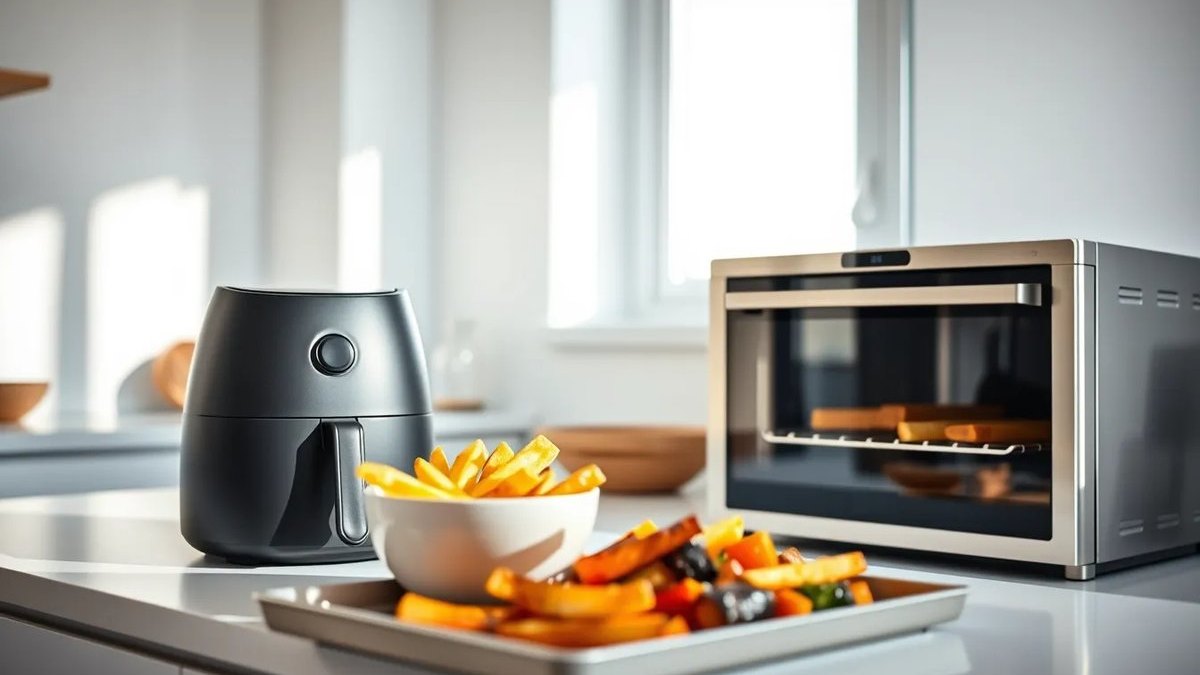
AI-generated editorial illustration; cooking results, energy use, and capacity vary by model and recipe—check the manufacturer's guidance and measure your counter space before buying.
Hot-air cooking has taken over the modern kitchen. Air fryers went from novelty gadget to everyday staple in just a few years, while convection ovens—countertop units or a fan setting on a full-size range—have quietly offered faster, more even cooking for decades. That overlap creates a common question: is an air fryer just a small convection oven, and if so, do you really need both? The short answer is that they use the same basic idea—a fan circulating hot air—but in very different packages. An air fryer concentrates intense airflow in a small chamber for maximum crispiness and speed. A convection oven spreads gentler airflow across a larger space for capacity and versatility. In this 2026 comparison, we look at how each appliance works, how they compare on crispiness, speed, capacity, energy use, cleanup, and cost, and which one makes the most sense for your household size and cooking style.
How Air Fryers and Convection Ovens Work
Both appliances cook with forced hot air. A heating element warms the air, and a fan moves it around the food, which strips away the layer of cooler, moist air that normally surrounds food in a still oven. That's why convection cooking tends to brown better and finish faster than conventional baking.
An air fryer takes this idea to an extreme. The heating element sits close to the food, the fan is powerful relative to the small cavity, and food usually rests in a perforated basket so air reaches every side. The result is fast browning that mimics deep-fried texture with far less oil.
A convection oven is a larger, more traditional oven with a fan added. Countertop convection ovens look like oversized toaster ovens, while built-in ranges often offer a convection or "fan bake" setting. Some "true" or "European" convection ovens add a third heating element around the fan for even more consistent heat. The bigger cavity and gentler airflow make cooking more even but usually less intense than in an air fryer.
Crispiness and Cooking Results
If crispy food is your top priority, the air fryer usually wins. Frozen fries, chicken wings, breaded cutlets, roasted chickpeas, and leftover pizza come out especially well because the hot air hits the food from close range on all sides.
Convection ovens also crisp food nicely, particularly on a wire rack set over a sheet pan, but they rarely match an air fryer's intensity unless the model includes a dedicated air-fry setting and basket. Where convection ovens shine is evenness and gentleness: cookies, cakes, casseroles, and large roasts generally do better in a convection oven, since an air fryer's strong airflow can over-brown the top before the inside is done.
One tip for both: avoid overcrowding. Air needs room to circulate, so single layers and space between pieces produce the crispiest results. When using convection in a recipe written for a conventional oven, many cooks lower the temperature by about 25°F (around 15°C) or check for doneness earlier.
Speed and Convenience
Air fryers are hard to beat for speed on small portions. Most need little or no preheating, and frozen snacks, leftovers, or a couple of salmon fillets are often done quickly.
Convection ovens take longer to preheat, especially full-size built-in models, but they make up for it when you are cooking more food. A countertop convection oven can roast a sheet pan of vegetables and chicken thighs in one go, and a full-size oven can handle several trays at once. For one or two people, the air fryer is often faster from start to finish; for a family dinner, the convection oven often wins because you aren't cooking in multiple batches.
Capacity and Versatility
Capacity is the biggest practical difference. A typical single-basket air fryer comfortably feeds one to three people. Larger, dual-basket, and oven-style models can stretch to a family of four or more, though big meals may still need batches.
Convection ovens offer far more room. A countertop model can often fit a 9x13-inch pan, a 12-inch pizza, or a small whole chicken, and a built-in range handles holiday turkeys and multiple dishes at once. Convection ovens also bake, broil, toast, slow roast, and on some models dehydrate or proof dough.
If you want one appliance that does a bit of everything, look at an air fryer toaster oven combo. These countertop convection ovens add a stronger fan and an air-fry basket, offering a middle ground: more capacity and versatility than a basket air fryer, with crispiness that's usually good but sometimes not quite as strong.
Energy Use and Running Costs
Both appliances can save energy compared with heating a full-size oven for small meals. Because an air fryer heats a small space for a short time, it typically uses less electricity per meal when cooking modest portions. Countertop convection ovens fall in between, and full-size ovens generally use the most energy when you're only cooking a little food.
The savings depend on how you cook. Using an air fryer instead of a big oven for single portions adds up over a year, but if you'd need three air fryer batches to feed six, one round in the oven may be just as efficient. Energy prices vary by region, so actual savings differ.
Counter Space, Cleanup, and Cost
Air fryers have a relatively small footprint but can be tall, so check the clearance under your cabinets and leave space around vents as the manual directs. Baskets and trays are usually nonstick and often dishwasher-safe, making cleanup quick.
Countertop convection ovens are wider and deeper and can dominate a small counter. Cleanup involves racks, pans, and a crumb tray, and the interior walls can collect grease over time.
On price, basic air fryers are among the more affordable small appliances, with larger, dual-basket, and smart models costing more. Countertop convection and air fryer toaster ovens span a similar budget-to-premium range. Whatever you buy, look for easy-to-read controls, a reliable thermostat, solid reviews for durability, and safety certifications such as UL or ETL listings.
Health and Safety Considerations
Air fryers are often praised as a healthier alternative to deep frying because they need much less oil, which can cut fat and calories in fried-style foods—though an air-fried frozen snack is still a frozen snack. Convection ovens offer similar benefits for roasting with modest oil. For any high-heat cooking, aim for golden rather than dark brown or burnt starchy foods, use a food thermometer for meat and poultry, and never block air vents.
Specifications at a Glance
| Detail | Air Fryer | Convection Oven (Countertop or Built-In) |
|---|---|---|
| How it works | A compact cooking chamber with a powerful top-mounted heating element and fan that blasts hot air around food in a basket or on a perforated tray | A traditional oven cavity with a fan (and sometimes a third heating element) that circulates hot air for more even, faster cooking than a standard oven |
| Crispiness | Excellent; the small space and intense airflow brown and crisp food quickly with little or no oil | Good; browns well, though usually less intensely than an air fryer unless the model has a dedicated air-fry mode |
| Cooking speed | Very fast; little or no preheating and many foods finish sooner than in a full-size oven | Moderate; needs preheating, but convection typically cooks somewhat faster than conventional bake |
| Capacity | Small to medium; common basket sizes suit roughly one to four people, with dual-basket and larger oven-style models for bigger households | Medium to large; countertop models fit a sheet pan or a whole chicken, and built-in ovens handle multiple racks and holiday-size meals |
| Versatility | Best at fries, wings, nuggets, reheating, and roasting small batches of vegetables; limited room for large roasts, casseroles, or sheet-pan meals | Very high; bakes, roasts, toasts, broils, dehydrates on some models, and cooks several dishes at once |
| Energy use | Generally low for small batches because it heats a small space for a short time | Moderate; countertop models use less energy than a full-size oven, while built-in ovens use the most for small portions |
| Counter space and cleanup | Compact footprint but tall; nonstick baskets are easy to clean, and many are dishwasher-safe | Countertop models take up more width and depth; racks, trays, and crumb trays need regular cleaning |
| Best for | Singles, couples, and small families who want fast, crispy results and quick weeknight meals | Families, bakers, batch cooks, meal preppers, and anyone who wants one appliance for a wide range of dishes |
Published article details, not a live feed. A dash means the article does not record that detail. On small screens, scroll the table horizontally.
Key differences in recorded specifications
- How it works
- Air Fryer: A compact cooking chamber with a powerful top-mounted heating element and fan that blasts hot air around food in a basket or on a perforated tray; Convection Oven (Countertop or Built-In): A traditional oven cavity with a fan (and sometimes a third heating element) that circulates hot air for more even, faster cooking than a standard oven.
- Crispiness
- Air Fryer: Excellent; the small space and intense airflow brown and crisp food quickly with little or no oil; Convection Oven (Countertop or Built-In): Good; browns well, though usually less intensely than an air fryer unless the model has a dedicated air-fry mode.
- Cooking speed
- Air Fryer: Very fast; little or no preheating and many foods finish sooner than in a full-size oven; Convection Oven (Countertop or Built-In): Moderate; needs preheating, but convection typically cooks somewhat faster than conventional bake.
- Capacity
- Air Fryer: Small to medium; common basket sizes suit roughly one to four people, with dual-basket and larger oven-style models for bigger households; Convection Oven (Countertop or Built-In): Medium to large; countertop models fit a sheet pan or a whole chicken, and built-in ovens handle multiple racks and holiday-size meals.
- Versatility
- Air Fryer: Best at fries, wings, nuggets, reheating, and roasting small batches of vegetables; limited room for large roasts, casseroles, or sheet-pan meals; Convection Oven (Countertop or Built-In): Very high; bakes, roasts, toasts, broils, dehydrates on some models, and cooks several dishes at once.
- Energy use
- Air Fryer: Generally low for small batches because it heats a small space for a short time; Convection Oven (Countertop or Built-In): Moderate; countertop models use less energy than a full-size oven, while built-in ovens use the most for small portions.
- Counter space and cleanup
- Air Fryer: Compact footprint but tall; nonstick baskets are easy to clean, and many are dishwasher-safe; Convection Oven (Countertop or Built-In): Countertop models take up more width and depth; racks, trays, and crumb trays need regular cleaning.
- Best for
- Air Fryer: Singles, couples, and small families who want fast, crispy results and quick weeknight meals; Convection Oven (Countertop or Built-In): Families, bakers, batch cooks, meal preppers, and anyone who wants one appliance for a wide range of dishes.
Similarities in recorded specifications
No identical values are recorded for matching specification labels.
These observations compare matching labels and exact published values only; they do not establish equivalent test conditions or a performance advantage.
Pros, cons, and criterion-level evidence
Consider the specifications and verdict in light of your priorities.
No numeric score is assigned. The verdict below is supplied editorial guidance, not a universal ranking.
The Verdict
Choose an air fryer if you cook mostly for one to three people, love crispy food, want the fastest results with minimal preheating, and value easy cleanup—it's an excellent, affordable addition to almost any kitchen. Choose a convection oven if you feed a larger family, bake regularly, cook sheet-pan meals or big roasts, or want a single appliance that handles the widest range of dishes; a countertop model is a great alternative to heating a full-size oven. In 2026, many households will be happiest with an air fryer toaster oven combo, which blends convection capacity with strong air-fry performance, or with a compact air fryer alongside a range that already has a convection setting. Measure your counter space first and choose the appliance that fits the meals you actually make.
Sources and methodology
Publication date: October 8, 2026. Prices and specifications are not live; check current details before deciding.
- LG USA Support – Understanding Convection Cooking · Accessed: 2026-10-09
Manufacturer guidance to lower a conventional recipe's temperature by about 25°F for convection bake (supports the 25°F / check-earlier tip).
- Consumer Reports – Air Fryer Buying Guide · Accessed: 2026-10-09
Independent tester's overview of air-fryer types, capacity limits and countertop/toaster-oven air-fry combos (supports capacity and combo-appliance points).
Editorial context: Read the editorial policy.
Frequently asked questions
- Should I choose Air Fryer or Convection Oven (Countertop or Built-In)?
- Choose an air fryer if you cook mostly for one to three people, love crispy food, want the fastest results with minimal preheating, and value easy cleanup—it's an excellent, affordable addition to almost any kitchen. Choose a convection oven if you feed a larger family, bake regularly, cook sheet-pan meals or big roasts, or want a single appliance that handles the widest range of dishes; a countertop model is a great alternative to heating a full-size oven. In 2026, many households will be happiest with an air fryer toaster oven combo, which blends convection capacity with strong air-fry performance, or with a compact air fryer alongside a range that already has a convection setting. Measure your counter space first and choose the appliance that fits the meals you actually make.
- How do Air Fryer and Convection Oven (Countertop or Built-In) compare on how it works?
- Air Fryer: A compact cooking chamber with a powerful top-mounted heating element and fan that blasts hot air around food in a basket or on a perforated tray. Convection Oven (Countertop or Built-In): A traditional oven cavity with a fan (and sometimes a third heating element) that circulates hot air for more even, faster cooking than a standard oven. These are the article's stated details; verify current specifications before deciding.
- When was this comparison published, and are its prices live?
- Published October 8, 2026. Prices and specifications in this article are not a live feed. Check the provider's current information. Available sources are listed on this page.